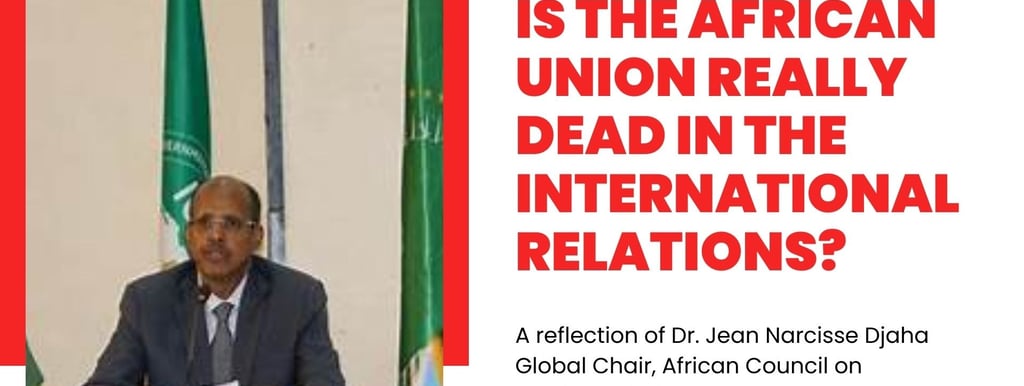
Is the African Union Really Dead in Today’s International Relations?
This op-ed argues that at a moment of profound global upheaval—from great‑power rivalry to wars, climate shocks, and the race for critical minerals—the African Union Commission has fallen disturbingly silent. As global powers reshape the international order, Africa’s continental institution is absent from the table, forfeiting influence at the very moment the continent’s strategic value is rising. The piece challenges the AU’s retreat from leadership and warns that continued silence risks rendering the Union irrelevant in today’s international relations.
By Dr. Jean Narcisse Djaha, Global Chair, African Council on Foreign Relations
3/19/20262 min read
The international system is undergoing its most dramatic transformation since the end of the Cold War. Wars in Europe and the Middle East are redrawing alliances. Global supply chains are fracturing. The race for critical minerals is accelerating. Climate shocks are destabilizing entire regions. Artificial intelligence is reshaping security, economics, and governance. In this moment of profound global upheaval, every region of the world is fighting to assert its place in the emerging order.
Except Africa.
And the silence is not coming from its people, its scholars, or its civil society. It is coming from the very institution created to defend the continent’s collective interests: the African Union Commission.
A Global System in Motion, and an African Union Standing Still
As major powers compete for influence—from Washington and Beijing to Moscow, Ankara, and the Gulf capitals—Africa has become central to global strategy. Its minerals fuel the green transition. Its population will shape the future labor force. Its geography is critical to maritime security. Its markets are essential to global growth.
Yet at the very moment when Africa’s leverage is rising, the AU Commission has retreated from the global stage. When coups sweep across West and Central Africa, the Commission hesitates. When foreign militaries expand their presence on African soil, it remains muted. When global powers negotiate climate, trade, or security frameworks that will define Africa’s next century, the AU is too often absent from the room.
In a world where power rewards presence, Africa’s continental institution has chosen silence.
Silence Has a Cost
In today’s multipolar world, silence is not neutrality—it is forfeiture. A continent that does not speak is spoken for. A continent that does not negotiate is negotiated over. A continent that does not project power becomes the terrain on which others project theirs.
This is not theoretical. It is visible in:
Global climate negotiations, where Africa—despite being the most climate‑vulnerable region—struggles to shape financing mechanisms.
Critical mineral agreements, where external powers secure long-term access while African institutions remain sidelined.
AI governance debates, where Africa’s demographic future is discussed without African leadership at the table.
Security realignments, where foreign military bases proliferate while the AU Commission offers little strategic direction.
The world is moving quickly. The AU is not moving at all.
A Crisis of Purpose, Not Capacity
The African Union has the mandate, the legitimacy, and the institutional memory to lead. It has the diplomatic infrastructure to shape continental positions. It has the moral authority to speak for a billion people. What it lacks is urgency.
The AU Commission’s reluctance to take firm positions in moments of crisis undermines its credibility. It signals to global powers that Africa’s continental voice can be ignored. And it signals to African citizens that the institution created to defend them is unwilling to confront the challenges that define their lives.
The Question That Cannot Be Avoided
Is the African Union dead in today’s international relations?
Not yet. But its silence is the sound of an institution drifting toward irrelevance at the very moment when Africa’s strategic value is rising. The world is being reordered. New alliances are forming. New rules are being written. And Africa’s future is being shaped—whether the AU participates or not.
The continent deserves an institution that rises to the moment. One that speaks with clarity, acts with conviction, and defends Africa’s interests without apology. History will judge whether this period of silence was a temporary lapse—or the quiet collapse of an institution that once promised to carry Africa’s voice into the global arena.
The African Union must choose to live or die.
La Fédération
© 2025. All rights reserved.
Rejoindre Le Mouvement
Notre Gouvernance
Notre Réseau Mondial
Nos Capitales
Notre Président Fondateur
Espace Membre
Notre Histoire
Membres Jeunes Leaders
L’International President Organization est la fédération mondiale d’une jeunesse qui se lève pour bâtir un monde plus juste, plus pacifique et résolument progressiste. Elle rassemble des jeunes engagés, porteurs d’une vision audacieuse et d’un sens profond de la responsabilité, déterminés à transformer les systèmes, à défendre la dignité humaine et à ouvrir de nouveaux horizons pour les générations futures.
Axes d'Intervention
Nos Activités
Nos Initiatives
IPO Global Perspectives
Pré - Congrès Mondial
Premier Congrès Mondial
Nos Événements
Moment of the President
Publications
Summit of NextGen Presidential Leaders
Membres Leaders Seniors